
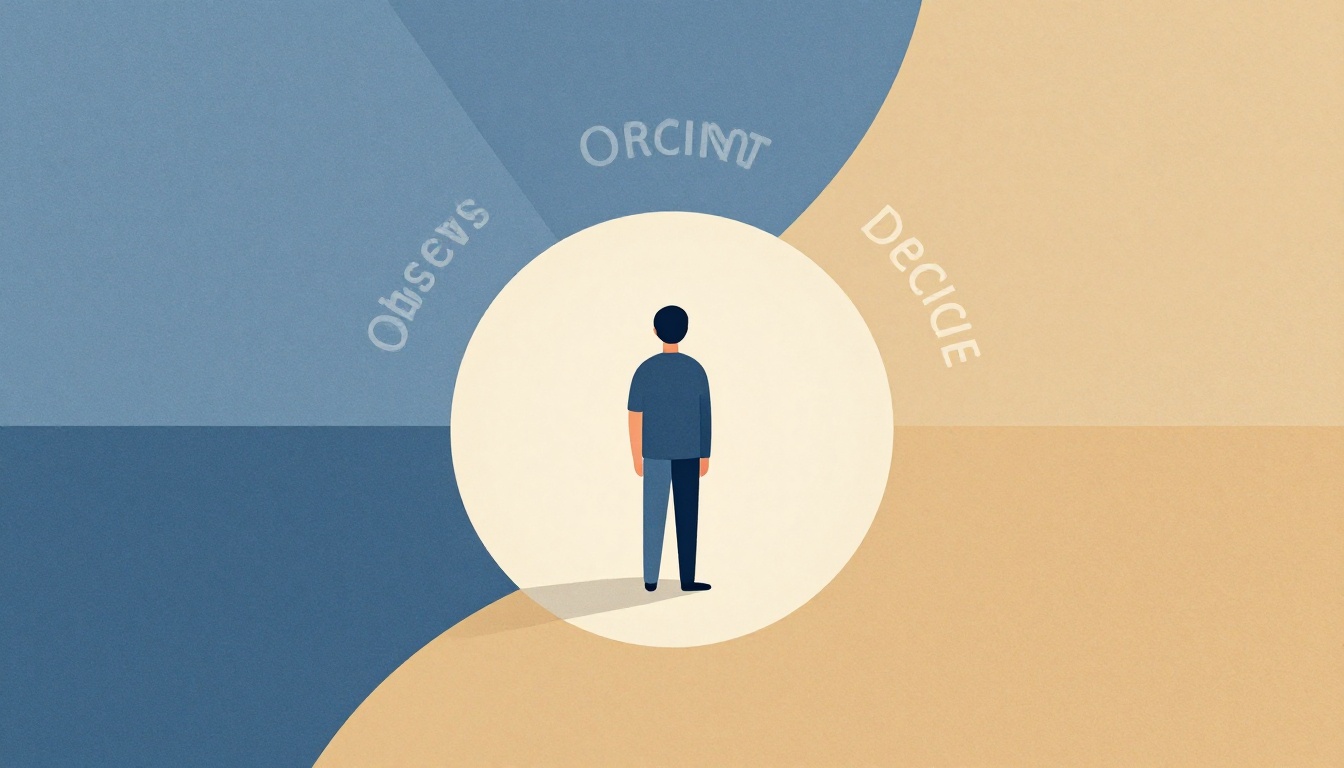
Which stage of the OODA loop did John Boyd consider the most critical?
Select one answer.
Why your decision-making process needs an upgrade
When markets shift, competitors disrupt, or a crisis hits, slow decision-making can cost your organization its edge. Traditional planning cycles are too rigid for today's volatile environment. You need a framework designed for speed and adaptation.
The OODA loop—Observe, Orient, Decide, Act—is a decision-making model developed by U.S. Air Force Colonel John Boyd in the early 1970s. Originally created for air combat, it helps individuals and organizations make effective decisions in rapidly changing conditions by continuously cycling through four stages source.
The four stages of the OODA loop
1. Observe
Gather real-time data from multiple sources. This includes market intelligence, customer feedback, competitor moves, and internal performance metrics. The goal is to build situational awareness without filtering prematurely. Boyd emphasized that observations come from many paths, including your own decisions and actions source.
2. Orient
This is the most critical and complex stage. You synthesize observations with your existing mental models—shaped by culture, experience, and knowledge—to form a meaningful understanding of the situation. Boyd saw orientation as the heart of the loop because it determines how you interpret what you see source.
3. Decide
Based on your orientation, select a course of action. Treat this as a hypothesis rather than a permanent commitment. In fast-moving environments, a good-enough decision made quickly often beats a perfect decision made too late.
4. Act
Execute your decision. Your actions change the situation, which feeds back into the next observation phase. The loop repeats continuously, enabling rapid adaptation.
How to apply the OODA loop in your organization
Actionable checklist for leaders
- Shorten your observation cycle. Set up real-time dashboards and regular briefings to reduce the lag between events and awareness.
- Challenge your orientation. Regularly question assumptions and mental models. Invite diverse perspectives to avoid groupthink.
- Make decisions faster. Establish clear decision rights and empower teams to act without excessive approval layers.
- Create feedback loops. After each action, measure outcomes and feed that data back into observation.
Real-world application: supply chain disruption
Imagine your company discovers a major supplier is suddenly going out of business. Using the OODA loop, you would:
- Observe: Gather data on the supplier's status, inventory levels, and alternative sources.
- Orient: Analyze the impact on production timelines and customer commitments.
- Decide: Choose a backup supplier or adjust production schedules.
- Act: Execute the new plan and monitor results.
By cycling through these steps quickly, you minimize downtime and maintain customer trust.
Why speed matters
According to Boyd, an entity that can process the OODA cycle faster than an opponent can "get inside" the opponent's decision cycle and gain a decisive advantage source. In business, this translates to outmaneuvering competitors by responding to changes before they do.
Common pitfalls to avoid
- Analysis paralysis in the Observe stage. Too much data can slow you down. Focus on actionable signals.
- Ignoring the Orient stage. Jumping from observation to decision without proper orientation leads to poor choices.
- Treating the loop as linear. Boyd's model is nonlinear with feedback loops running in multiple directions. Expect to revisit earlier stages as new information emerges.
Quiz: Test your understanding
Which stage of the OODA loop did John Boyd consider the most critical?
A) Observe B) Orient C) Act
How the Featured Expert Can Help
Dana R. Gordon of D.R. Gordon Consulting offers leadership development and executive coaching tailored to small and mid-sized organizations. His personalized approach helps leaders sharpen decision-making and build adaptive teams. Visit his website to learn more about his services and access a free guide.